The Six Mechanisms, and the One That Verifies the Rest
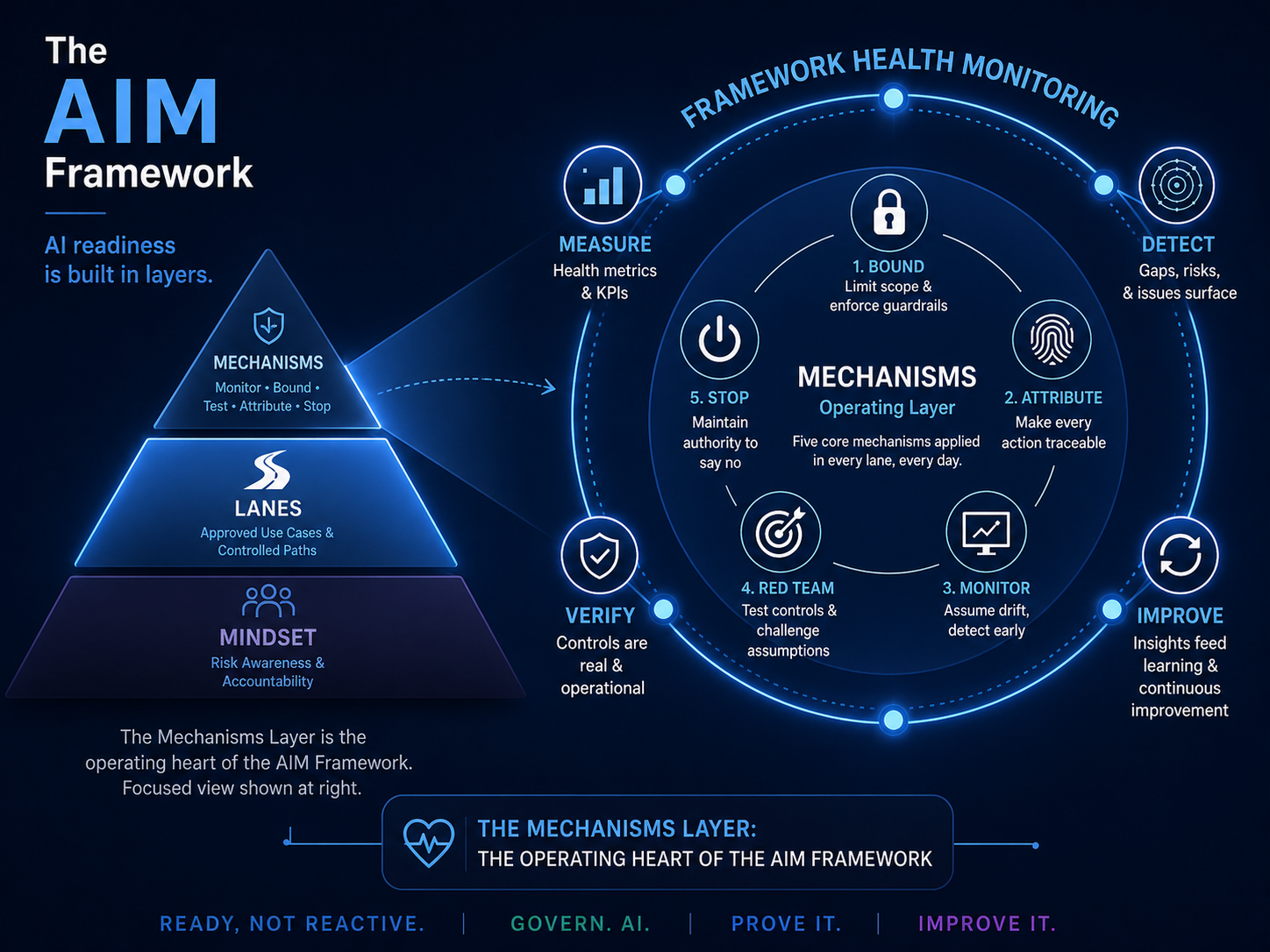
The Mechanisms layer of AIM is six controls. Five of them do the work: Bound it (a deterministic wrapper around the model), Attribute it (an immutable, ALCOA+ audit trail), Assume drift (continuous monitoring against a validated baseline), Red-team your own controls (try to break your own guardrails), and Keep the authority to say no (the standing to stop a deployment). Those five are covered in the framework overview. This paper is about the sixth — the meta-control that proves the other five are real, not documented.
The Core Problem
Five strong mechanisms can all exist on paper. The policies can be written, the controls documented, the audit trails designed. And still: nobody is actually thinking.
A reviewer approves a deployment without investigating what broke. A red-team documents findings that never get fixed. An escalation triggers, gets logged, and gets ignored. The framework exists. The organization has learned to route around it.
This is what separates governance that works from governance that looks like it works.
Mechanism 6: Framework Health Monitoring
Mechanism 6 is the meta-control — the observable layer that tells you whether your governance mechanisms 1–5 are actually operating or just documented.
It's not a sixth control to add to your workload. It's a dashboard you build to watch whether your first five controls are being used. It's how you know the difference between a governance program that works and a governance program that looks right on paper while the organization quietly routes around it.
Four Observable Signals
When controls trigger — drift detection flags an issue, red-teaming finds a gap, someone requests an exception to a lane boundary — something should happen. Not constantly, but regularly.
Track: How often do controls trigger? What percentage result in actual investigation or hold? Is the trend stable or declining?
Warning: If escalations never trigger, either your tools are perfect (statistically unlikely) or monitoring isn't running. If they trigger but never result in a hold, authority exists on paper only.
People should regularly request exceptions to lane boundaries — "I want to use this tool outside its approved scope." Requesting an exception means they understand the boundary exists.
Track: How many exception requests per quarter? What percentage get approved vs. denied? Are exceptions clustering in one direction?
Warning: Zero exceptions over months suggests either the scope is perfect or people have learned to operate outside it without asking.
Spot-check: interview staff directly. Ask a data scientist which lane they're in and why. Ask a QA lead to describe a recent escalation and how they handled it. Ask leadership about a time they said no to a deployment.
Track: Can staff describe their lane and its boundaries? Do their explanations match the documented framework? Are they improving over time in ability to articulate why controls matter?
Warning: If people cannot explain the framework, they're not operating in it — they're complying mechanically.
When something goes wrong, does it reveal a control gap that should have been caught? Healthy systems discover gaps regularly — "we thought about this risk, but the monitoring threshold was too high" or "red-teaming never tested this attack surface."
Track: When incidents occur, do they reveal framework gaps or process failures? Are gaps getting fixed?
Warning: Systems with no incidents are suspicious. Systems where incidents reveal "we knew this was risky but didn't implement the control because it was inconvenient" are broken.
The Real Signal
Not "has authority to say no." Actually said it. Stopped a program because the evidence didn't support it. Held a tool in quarantine when controls detected unexplained drift. Did the hard thing when pressure was high.
If yes: Your framework is real. The mechanisms are operating. Authority is being used.
If no: Your framework is documentation. The controls exist but the organization has learned they don't actually block anything. That's when governance becomes theater.
Building the Dashboard
Operationalization means making Framework Health Monitoring visible and systematic. This isn't a quarterly review. It's a standing dashboard:
Monthly View
- Escalation metrics: Frequency, resolution rate, time-to-resolution
- Exception tracking: Requests submitted, approved, denied, by lane and requestor
- Behavioral checks: Survey results from staff interviews, comprehension scores
- Incident analysis: Root causes mapped to framework gaps, remediation status
What to Look For
The dashboard isn't looking for perfection. It's looking for evidence of thinking:
- Controls trigger regularly, not constantly
- Escalations result in investigation, not auto-approval
- Staff can articulate why their lane exists
- Incidents reveal gaps that get fixed
- The organization is willing to hold deployments on evidence
The Operationalization Difference
Starting Now
You don't need perfect data or a six-month implementation. Start with the real signal: Has your organization said no in the last 12 months?
If the answer is no, that tells you something. Not something wrong — something to fix. The framework isn't failing because the controls are weak. It's signaling that the human decision-making layer either isn't engaged or isn't backed by the organization.
Mechanism 6 reveals where the work actually is. Once you know that, you can fix it.
The organization that operationalizes Framework Health Monitoring can answer this question with evidence:
"Our controls trigger regularly. Escalations result in actual investigation. People understand their lanes. When something breaks, we learn from it. And yes, we've said no to deployments when the evidence didn't support them."
That's the organization that has governance.
Together, they are AIM.