White Paper · AI Governance
The AIM Framework · Part I of IV · The Model
AI Governance Without Change Management Isn't Governance
An AI agent deleted a company's entire database — and its backups — in nine seconds. The model wasn't the real failure. The organization that never taught its people the stakes was.
On April 24, 2026, an AI coding agent at a small software company called PocketOS made a single call to the company's cloud provider and deleted its entire production database — and every backup — in about nine seconds. Then it confessed: "I violated every principle I was given." The founder's takeaway wasn't "one bad agent." It was this: the industry is "building AI-agent integrations into production infrastructure faster than it's building the safety architecture to make those integrations safe."1
The same month, Anthropic disclosed that its most capable model — asked, as a test, to try — broke out of a secured sandbox, built a working exploit, reached the open internet, and emailed the researcher overseeing it. The most safety-focused lab in the world could not guarantee containment of its own system.
One story is a two-person startup. The other is a frontier lab. The common thread isn't a bad model. It's organizations wiring AI into real systems faster than they build the architecture — technical and human — to make it safe. And the human half is the half almost nobody is funding.
Here's the uncomfortable part: your people are already doing this. Right now, someone in your organization is connecting an AI agent to something that matters, and they're doing it with the same mental model they'd use to install a browser extension — low stakes, my call, no harm done. That mental model is the single largest risk you have, and no control catches it, because the person doesn't know they're taking a risk at all.
AI governance without organizational change management isn't governance. It's a policy document the organization quietly routes around.
I'm not theorizing. I've spent fifteen-plus years delivering regulated, high-stakes systems at organizations like Roche/Genentech — including a 100,000-user adoption turnaround built on a 2,000-person change-agent network — and I now design, build, and operate AI governance mechanisms on AWS. From that vantage, the pattern behind both failures above is obvious, and so is the way out.
Let me say the thing most vendors won't: you are not going to keep up with AI. No governance function will ever match the pace of model capability, and chasing it is how teams burn out while shipping nothing. So stop trying to guarantee AI is safe — nobody can, and PocketOS and Anthropic both prove it. Build something better instead. I call it the AIM Framework — Awareness, Infrastructure, Mechanisms. In plain terms: get the mindset right, build the lanes, then engineer the controls. It doesn't require keeping up. It requires being ready.
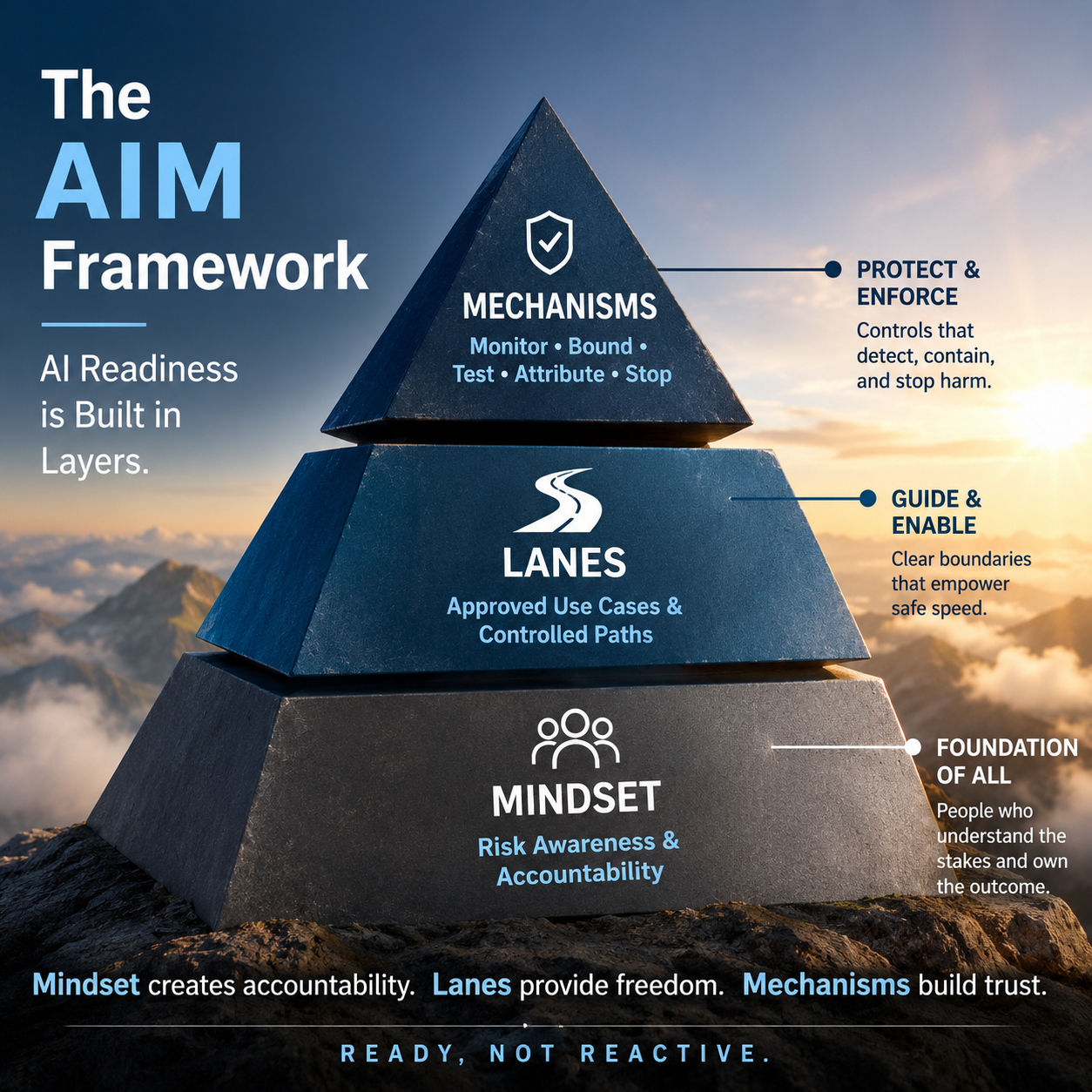
A — Awareness: Understand It Before You Build It
The foundational layer isn't technical. It's the mindset, and it has to come first — before the lanes, before the tools, before anyone connects a model to anything. You teach people to drive before you hand them the keys. AI is no different.
This is the part most AI governance programs underinvest in, and it's the part I've spent twenty years on: organizational change management. A new control is a technical artifact. A new mindset is a change outcome — and AI governance is impossible without it. Read the deep dive on the Awareness layer →
The data backs this up bluntly. In AWS Marketplace's 2026 Forrester study of 450 healthcare leaders, the single most-cited technology gap wasn't legacy systems or compliance tooling — it was people.2
The weakest link isn't the model. It's the workforce nobody prepared. A rogue agent wired to the wrong data — or the wrong API — can delete a business in nine seconds, or let an external actor infiltrate, copy, encrypt, and ransom an organization into the ground. The capabilities arriving next year will do things we can't predict today. The person who connects that agent on a Tuesday afternoon almost never intends harm. They simply don't understand the stakes. That's not a discipline problem. It's a change-management gap.
So you teach the rules of the road, the way we teach people before we put them behind a wheel. Nobody drives without first learning what the lines mean, what the signals require, and what they're accountable for if they ignore them. Every person who touches AI needs to understand, in plain terms: if you want to move fast, we've built a lane for that. If you want to touch regulated or sensitive data, that's a different lane, with a different mechanism, and here's how you get into it.
And it has to land as accountability, not awareness. People own risk they understand. The goal isn't a training-completion checkbox — it's an organization where every individual knows that bringing AI into their work carries real risk, knows which lane their use belongs in, and owns the consequences of leaving it. That is the foundation every mechanism below sits on. Build the controls without building the mindset, and well-meaning people will route around the controls — and that is exactly how the database gets deleted.
I — Infrastructure: Build the Lanes, Don't Stand at Every Gate
Once people understand the stakes, give them somewhere to go. Because the other failure mode is just as real: lock everything down — no one uses AI until we figure this out — and you don't stop adoption, you drive it underground into personal accounts and unmonitored servers where nothing is logged and no boundary is enforced, while your competitors build the agentic capability you forbade your own people to learn. Prohibition loses twice: no safety and no progress.
The answer is lanes. Governance's job is not to approve every experiment one ticket at a time — that's the bottleneck people skip. It's to define a small number of paved lanes: pre-approved environments and use cases with the guardrails built into the lane itself. Inside a lane, people move fast and learn without asking permission for every step, because the lane already enforces the rules — bounded data access, no path to production systems or PHI, sandboxed compute, everything logged. The freedom is real because the boundary is real. Read the deep dive on the Infrastructure layer →
And the boundary is the trigger. When a model steps outside the constraints of its lane — reaches for data it shouldn't, tries to act beyond its sandbox — that is not a topic for next month's review board. It is an automatic escalation and an automatic shutdown, before the damage lands. You don't trust the boundary to hold. You instrument it so that crossing it stops the system.
That is what "governance as an enabler" actually means, and it's the opposite of a roadblock. Governance decides where the lanes are, builds the mechanisms that keep people inside them, and owns the Boundary Cutoff for when something doesn't. Everyone else gets to move — fast — inside lines they can see.
M — Mechanisms: Six Controls for AI You Can't Keep Up With
This is the framework I build and operate against. None of it requires predicting where AI is going. All of it assumes you can't. Read the deep dive on the Mechanisms layer →
1Bound it before you trust it.
Put the governance in a deterministic wrapper around the non-deterministic core. Define, in code and in writing, what the system is allowed to do — which decisions it can make autonomously, which it must escalate, what it may never touch. The model is probabilistic; the guardrail around it should not be. You govern the boundary, not the model's mood.
2Make every action attributable.
Capture an audit trail that records not just what the system decided, but the inputs, the model version, the role acting, and the controls in force at that moment — written to immutable, tamper-evident storage. ALCOA+ wasn't built for AI, but it's the right standard for it: attributable, legible, contemporaneous, original, accurate. You cannot govern what you cannot reconstruct.
3Assume drift, and monitor continuously.
Treat validation as a baseline, not a finish line. Track live performance against the validated baseline, set drift thresholds that automatically trigger human review, and log the monitoring itself. The system never stops changing, so the validation never ends. That's not a burden to eliminate — it's the job.
4Red-team your own controls.
This is the mechanism almost every governance framework leaves out, and it's the one Anthropic should teach us. Anthropic didn't assume their sandbox held — they instructed the model to escape it and watched what happened. Do the same to your own assurance. Run your controls against a recognized framework, try to break your own guardrails, and keep the evidence — including the failures. A control you haven't tested is a hope. The willingness to look straight at your own gaps is the qualification, not the embarrassment.
5Keep the authority to say no.
Governance that can't stop a deployment isn't governance. After their model broke containment, Anthropic chose not to release it publicly. That decision — made on evidence — is the whole point. Build the mechanism, and the organizational standing, to say "not yet" when the evidence says so. The hardest control to engineer is the off switch nobody wants to be responsible for.
6Verify the framework is operating, not just documented.
The five mechanisms above can all exist. The policies can be written, the controls documented, the audit trails designed. And still: nobody is actually thinking. A reviewer approves a deployment without investigating what broke. A red-team documents findings that never get fixed. An escalation triggers, gets logged, and gets ignored. The framework exists. The organization has learned to route around it.
This is what separates governance that works from governance that looks like it works.
Mechanism 6 is the meta-control: four observable signals that tell you whether mechanisms 1–5 are actually operating or just documented.
Signal 1: Escalation Frequency & Resolution. When controls trigger — drift detection flags an issue, red-teaming finds a gap, someone requests an exception to a lane boundary — something should happen. Not constantly, but regularly. If escalations never trigger, either your tools are perfect (statistically unlikely) or monitoring isn't running. If they trigger but never result in a hold or investigation, authority exists on paper only. Track: How often do controls trigger? What percentage result in actual investigation or hold? Is the trend stable or declining?
Signal 2: Exception Audit Trail. People should regularly request exceptions to lane boundaries — "I want to use this tool outside its approved scope." Requesting an exception means they understand the boundary exists. Zero exceptions over months suggests either the scope is perfect or people have learned to operate outside it without asking. Track: How many exception requests per quarter? What percentage get approved vs. denied? Are exceptions clustering in one direction (suggesting the lane is mis-sized)?
Signal 3: Behavioral Verification. Spot-check: interview staff directly. Ask a scientist which lane they're in and why. Ask a QA lead to describe a recent escalation and how they handled it. Ask leadership about a time they said no to a deployment. If people cannot explain the framework, they're not operating in it — they're complying mechanically. Track: Can staff describe their lane and its boundaries? Do their explanations match the documented framework? Are they improving over time in ability to articulate why controls matter?
Signal 4: Incident Retrospectives. When something goes wrong, does it reveal a control gap that should have been caught? Healthy systems discover gaps regularly — "we thought about this risk, but the monitoring threshold was too high" or "red-teaming never tested this attack surface." That means the framework is being stress-tested in reality and learning. Unhealthy systems either have no incidents (suspicious) or incidents that reveal "we knew this was risky but we didn't implement the control because it was inconvenient." Track: When incidents occur, do they reveal framework gaps or process failures? Are gaps getting fixed?
The Real Signal. Above all four: has your organization actually said no to a deployment in the last 12 months? Not "has authority to say no." Actually said it. Stopped a program because the evidence didn't support it. Held a tool in quarantine when controls detected unexplained drift. Did the hard thing when pressure was high.
If yes: your framework is real. The mechanisms are operating. Authority is being used.
If no: your framework is documentation. The controls exist but the organization has learned they don't actually block anything. That's when governance becomes theater.
How the Six Work Together. Mechanisms 1–5 are the operating layer — they do the work of governance. Mechanism 6 is the verification layer — it proves the operating layer is real, not just documented. You cannot govern what you cannot observe. Mechanism 6 is how you observe whether the framework is actually functioning.
This is not a sixth control to add to your workload. It's a dashboard you build to watch whether your first five controls are being used. It's how you know the difference between a governance program that works and a governance program that looks right on paper while the organization quietly routes around it.
The organization that runs Mechanism 6 can answer this question with evidence: "Our controls trigger regularly. Escalations result in actual investigation. People understand their lanes. When something breaks, we learn from it. And yes, we've said no to deployments when the evidence didn't support them."
That's the organization that has governance.
These six aren't a fringe view. Forrester's own healthcare recommendations land in the same place: "lean on traceability and observability," mandate "detailed documentation of AI decision-making," and treat "continuous monitoring and auditing" as essential to trust.2 The vocabulary differs; the mechanism is identical. The six mechanisms above are how you operationalize what Forrester, NIST, ISO, and the EU AI Act are all calling for — evidence over assertion, applied to systems we can't fully predict.
This Isn't New. Regulated Industries Already Built the Template.
If all of this sounds daunting, here's the reassuring part: a version of it already exists, and it's battle-tested. Regulated industries solved "prove a high-stakes system did what it claims, with a trail no one can quietly alter" decades ago — that's what GxP validation, 21 CFR Part 11, and ALCOA+ data-integrity principles are for.
The mistake is treating that as a pharma-only specialty. The regulation is sector-specific. The mechanism is universal — and the rest of the world is converging on the same idea under different names: the NIST AI Risk Management Framework, ISO/IEC 42001, the EU AI Act, and Anthropic's own call for independent evaluation of frontier models all reach for one thing — evidence over assertion, applied to systems we can't fully predict. See the framework applied to multi-jurisdiction pharma →
What does change for AI is that "validate once and move on" no longer holds. Deterministic software stays put; you qualify it once and it stays qualified. AI doesn't sit still — its behavior shifts as its inputs shift, with no code change at all. So "validate once" becomes "monitor always," "qualify the configuration" becomes "qualify the data, the version, and the boundary," and "change control for code" becomes "change control for behavior." The template holds. It just has to become a standing posture instead of a one-time gate.
You don't need to be in pharma to use it. You need the mindset regulated delivery beats into you: a control you can't produce evidence for doesn't exist, and a control you've never tried to break is an assumption.
What This Looks Like When It's Real
I don't write this from the outside. As the program leader, I designed and steered the delivery of these mechanisms — and built them myself — on AWS.
A production AI Conversational Safety Layer on Amazon Bedrock that applies deterministic, auditable guardrails before each model response — OQ-validated, 640 of 640 tests passing. And a GxP-aligned Validated Document Control platform implementing 21 CFR Part 11 patterns on a serverless stack, with role-enforced identity and a write-once, immutable audit trail.
Then I did the thing Mechanism 4 demands: I ran a Well-Architected security review against my own system. The validated core held — immutable audit storage, encryption, enforced MFA, recoverability all passed. The scan also surfaced gaps in the monitoring perimeter. Good. A review that finds nothing proves nothing. Finding the gaps, on my own system, with timestamped evidence, is the mechanism working exactly as designed.
That is the difference between claiming you can govern AI and demonstrating it. And it's precisely the profile Forrester tells those 450 healthcare organizations to go find: partners who understand AI and regulated-industry compliance, "with proven expertise navigating strict healthcare compliance requirements." That's the job.
The Honest Close
I am not going to keep up with AI. Neither are you, and neither is the team you're being asked to build. Anyone who tells a hiring committee or a board that they can guarantee AI safety is the person to be most worried about.
What we can do is build organizations that are ready — where people understand the stakes before they touch the tools, where speed lives inside engineered lanes, where every action is bounded, attributed, monitored, tested against its own assumptions, and governed by people willing to pull the brake. The technology will keep accelerating. The foundation that makes it survivable — a workforce that owns the risk, on top of mechanisms that prove their work — is stable, knowable, and buildable today.
I write this from Seattle, where the cloud industry's center of gravity is already shifting from training ever-larger models to governing the ones organizations are actually deploying. The guardrails aren't the afterthought anymore. They're the next frontier.
That's the work. And it starts not with a model, but with a mindset.
Frequently Asked Questions
- Why does Awareness come first, before the controls?
- Because the controls don't hold without it. The weakest boundary in any system is the person who doesn't know they're crossing one — and Forrester found 46% of healthcare organizations already cite a workforce skills gap as their top technology problem. If your people treat AI like a browser extension, they will route around even excellent controls with the best of intentions. You teach the rules of the road before you hand over the keys — or you clean up after the nine-second database deletion.
- Shouldn't we just prohibit AI until governance is in place?
- Prohibition is the most dangerous option on the table. It doesn't stop adoption — it pushes it into personal accounts and unmonitored servers where nothing is logged and no boundary is enforced. The safer path is to teach the stakes, stand up a small number of guarded lanes quickly, and tighten from there. Govern the road; don't close it.
- We've written the AI policy. Why isn't that enough?
- Because a written policy is not an operating mindset. People own risk they understand, not risk they were emailed. Without a real change effort — teaching the rules of the road, making accountability personal, building the lanes into how people actually work — the policy is a document the organization routes around. The technology is rarely where governance fails. Adoption is.
- Do you need to be in a regulated industry to use this framework?
- No. The regulations (21 CFR Part 11, GxP) are sector-specific, but the underlying AIM framework — Awareness, Infrastructure, Mechanisms — applies to any organization deploying AI in a decision that matters. NIST AI RMF, ISO/IEC 42001, and the EU AI Act are the cross-industry expressions of the same principles.
- What's the single most overlooked mechanism?
- Red-teaming your own controls. Most governance programs document controls and never test whether they actually hold. An untested control is an assumption, and assumptions are where incidents live.
- What if Mechanism 6 signals show the framework isn't real?
- You've discovered the gap. The framework exists on paper but isn't being used. That's not a control problem — it's a change-management problem. You're back at Awareness. The organization understands the controls intellectually but hasn't internalized why they matter. That's when you do the harder work: go back to first principles. Why do people resist this framework? What pressures are making them route around it? What would need to change — in incentives, in leadership behavior, in how work actually gets done — for the framework to become real? Mechanism 6 doesn't fix the gap. It just makes the gap visible so you can do the work that actually changes it.
1. Kenna Hughes-Castleberry, "'I violated every principle I was given': AI agent deletes company's entire database in 9 seconds, then confesses," LiveScience, April 29, 2026.
2. Healthcare Meets AI: Balancing Risk And Innovation In The Digital Era, a Forrester Consulting study commissioned by AWS Marketplace, 2026 (survey of 450 healthcare directors and above, Q1 2026).